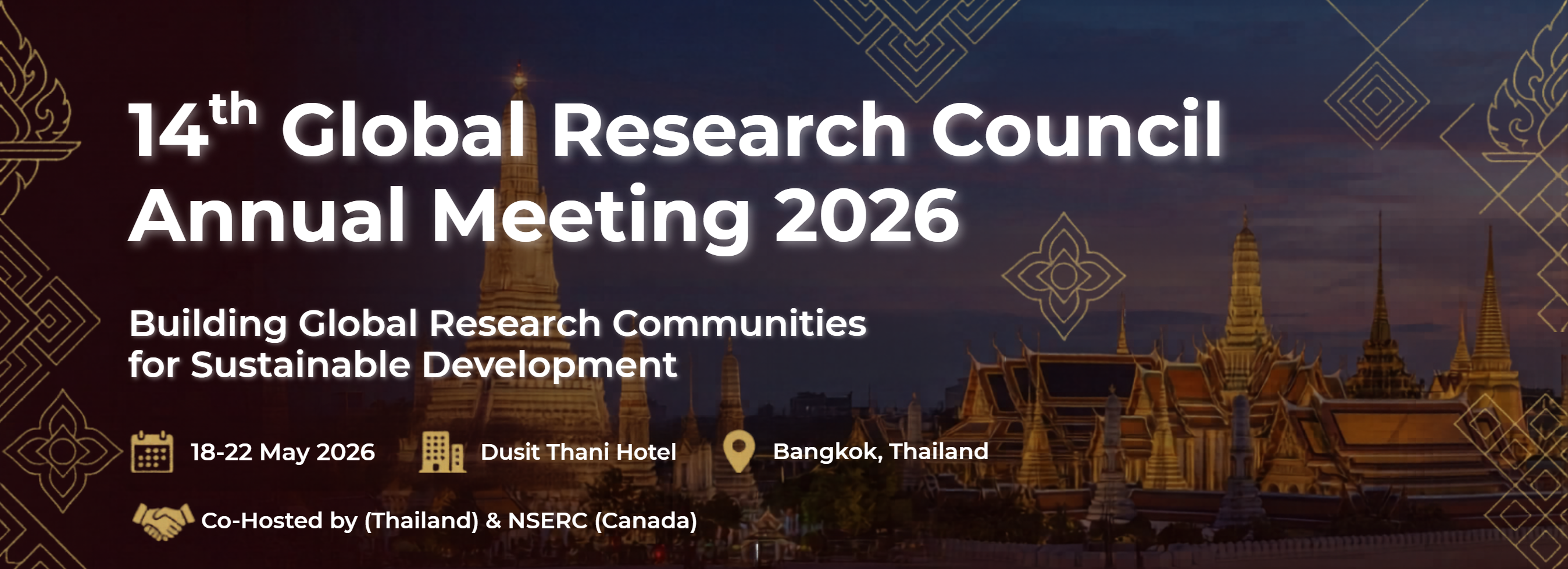
A summary of highlights from the 14th GRC Annual Meeting 2026
🔈 Audio is muted by default — click the speaker icon to unmute
.jpg)





%202.jpg)

.png)

%202.jpg)

18–22 May 2026 | Dusit Thani Hotel, Bangkok
ⓘ Click on side event titles to view organisations & programme details
| Time | Program | Venue |
|---|---|---|
| From 08:30 | Registration Reception | 3rd Floor |
| 09:00–10:30 | Parallel Sessions: Side Events | |
| 09:00–10:30 |
Organized by: NRF, South Africa · MESTI, Ghana · DOST, Philippines · KACST, Saudi Arabia This side event will explore how research funders can accelerate progress toward the Sustainable Development Goals (SDGs) by integrating open science, systems thinking, and SDG‑aligned impact metrics across the research cycle. Building on the UNESCO Recommendation on Open Science, the session will consider how its four pillars—open knowledge, infrastructures, communication, and engagement with diverse actors—can be embedded in funding strategies to strengthen transparency and inclusivity. It will highlight how systems approaches help funders understand interdependencies, design coherent portfolios, and support place‑based interventions. Participants will share practical experiences and co‑develop recommendations and candidate metrics to guide funders in designing transparent, accountable, and collaborative programmes that advance equitable, sustainable community outcomes. | Suriya 2nd Floor (100 pers) |
|
Organized by: Science Europe and RRA Working Group Research assessment sits at the heart of public research funding and strongly influences how research is conducted and valued. In recent years, responsible research assessment has gained global prominence, with growing leadership from the GRC, Science Europe, and international initiatives such as DORA and CoARA. While this expanding ecosystem offers valuable opportunities for collaboration and learning, it also presents practical challenges related to alignment, resourcing, and implementation. This session brings together key partners to map the current landscape, identify opportunities for coordination, and explore how funders—and the GRC—can act as catalysts for coherent and sustainable research assessment reform. | Lumpini 3rd Floor (120 pers) | |
| 10:30–10:40 | ☕ Coffee/Tea Break | |
| 10:40–12:10 | Parallel Sessions: Side Events | |
| 10:40–12:10 |
Organized by: Secretariat of the MENA Councils · NRF, South Africa · IDRC, Canada · NRCT, Thailand · Global Young Academy Open Science is most impactful when policy, practice, and people move in concert. This 90‑minute session blends (i) funders’ perspectives on operationalizing Open Science principles across the research and innovation landscape, (ii) inclusion of multiple knowledge cultures and community co‑creation, and (iii) empowerment of early‑ and mid‑career researchers (EMCRs) for open publishing, FAIR/CARE‑aligned data sharing, and science–society engagement. The format combines short invited presentations with a facilitated HORCs panel. The aim is to reframe inclusive and equitable Open Science for sustainable development by connecting policy to practice and community engagement, while foregrounding respect for diverse knowledge systems and capacity building for the next generation of researchers. | Suriya 2nd Floor (100 pers) |
| Side event 2 (Continuation): Enhancing and navigating global initiatives: the role of research funding organisations in international research and innovation movements on research assessment reform (Part 2) | Lumpini 3rd Floor (120 pers) | |
| 12:10–13:30 | 🍴 Lunch — Napalai, 1st Floor | |
| 13:30–15:00 | Parallel Sessions: Side Events | |
| 13:30–15:00 |
Organized by: MLE-WG · MESTI, Ghana · NRF, South Africa · ANII, Uruguay · IDRC, Canada · NWO, Netherlands · RCN, Norway · ANID, Chile · TCST, Tanzania The side event will review existing Multilateral Engagements (MLEs) across GRC regions and outline a roadmap for future cooperation. It draws on findings from a desk study and survey by the MLE Working Group, highlighting lessons learned, regional challenges, and opportunities to strengthen collaboration. Practical regional examples will show how coordinated efforts expand networks, foster inclusive participation, and transform national programmes into sustainable multilateral platforms. Through discussion, participants will help identify actionable options and clarify the GRC’s role in promoting equitable, diverse, and effective multilateral engagement, both globally and from a regional perspective. | Lumpini 3rd Floor (120 pers) |
|
Organized by: Science Europe · TÜBİTAK, Türkiye · MInT, Ethiopia · FUNDECIT, Angola · ANR, France · BRIN, Indonesia · NRF, South Africa · NSERC, Canada · RCN, Norway · TSRI, Thailand This side event will examine how Diamond Open Access, a community-driven scholarly publishing model, can advance inclusive and equitable open science for sustainable development. By removing financial barriers for readers and authors, Diamond OA strengthens research sovereignty, supports locally governed editorial practices, promotes multilingual dissemination, and increases the visibility of context-specific research. The discussion builds on growing global momentum around Diamond OA, aligned with the UNESCO Recommendation on Open Science and the 2022 Action Plan for Diamond OA. It also contributes to ongoing dialogue fostered through recent Global Summits on Diamond OA held in Mexico, South Africa, and India. | Silom 3rd Floor (70 pers) | |
| 15:00–15:30 | ☕ Coffee/Tea Break | |
| 15:30–17:00 | Parallel Sessions: Side Events | |
| 15:30–17:00 | Side event 4 (continuation): Multilateral Engagements: challenges and opportunities for regional cooperation (Part 2) | Lumpini 3rd Floor (120 pers) |
|
Organized by: UKRI, United Kingdom · ARC, Australia · SSHRC, Canada · NCRST, Namibia · RCN, Norway · JST, Japan · NRF, South Africa This side event explores how funders can improve the quality and impact of research investment by using metascience to generate better evidence for decision‑making. Senior leaders from four GRC regions will share insights from national experiments and reforms aimed at strengthening funding processes and supporting high‑risk, high‑reward research. A global overview of metascience trends will highlight how the field is expanding internationally, feeding into a panel discussion on what works—and what still needs testing—to enhance R&D systems. Reflections from Japan and South Africa, along with audience Q&A, will help shape a shared understanding of emerging priorities. | Silom 3rd Floor (70 pers) | |
| 17:00 | End of Business Day | |
| 17:15–18:30 | Executive Support Group (ESG) (closed session) | Silom 3rd Floor (70 pers) |